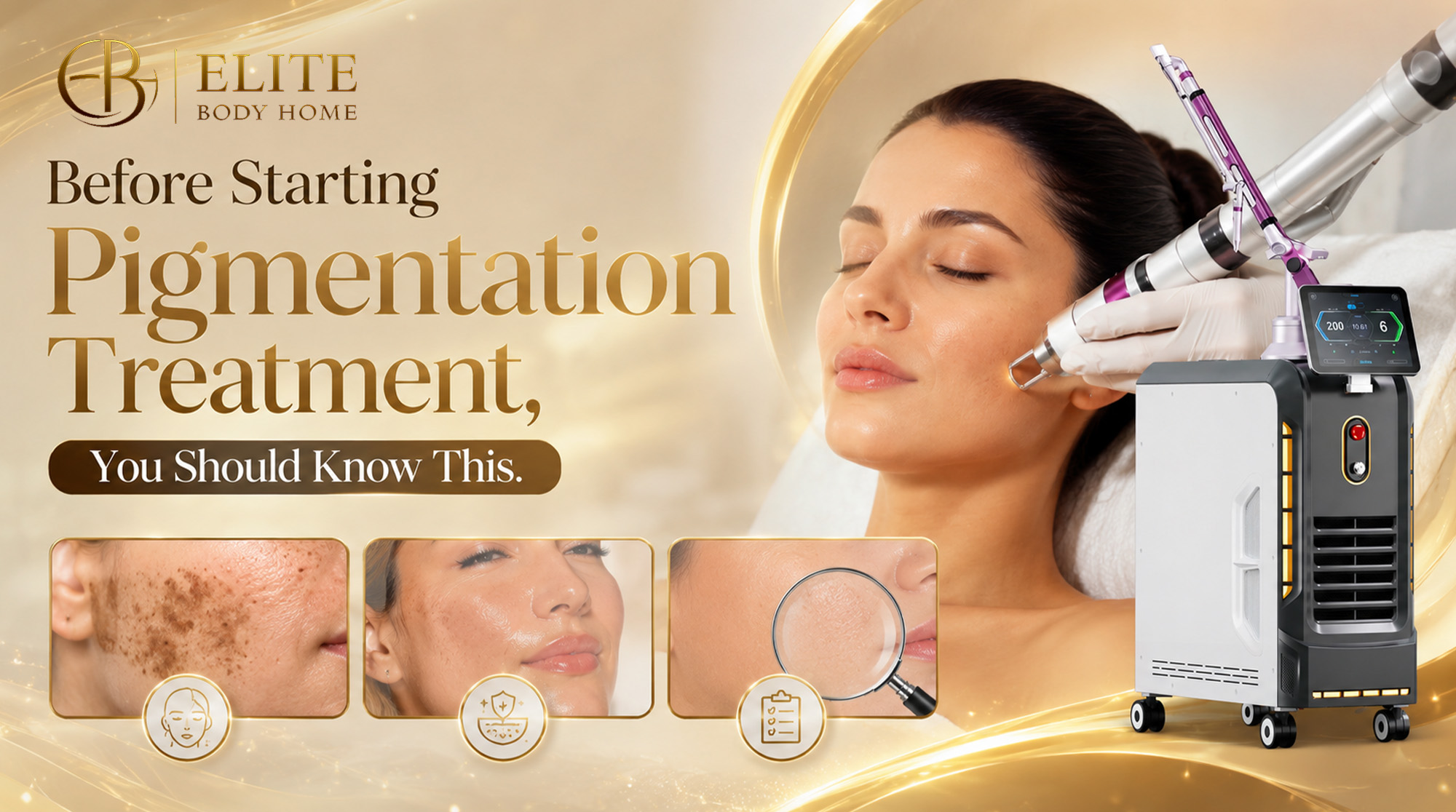
Before Starting Pigmentation Treatment, You Should Know This
Dark patches, melasma, sun spots, and post-acne marks are among the most common reasons patients walk into our clinic. And almost every one of them asks the same thing: “What’s the fastest way to get rid of this?” The honest answer — from a medical perspective — is that the fastest route is rarely the safest, and starting the wrong pigmentation treatment can make dark spots worse. Before you book anything, here’s what our medical team at Elite Body Home wants you to know.
Not All Pigmentation Is the Same
The word “pigmentation” covers several very different conditions, and each responds to a different protocol. A treatment that clears sun spots can trigger a flare of melasma. That’s why a proper diagnosis must come before any pigmentation removal plan.
The main types we see:
- Melasma — hormonally driven, symmetrical patches on the cheeks, forehead, or upper lip.
- Post-inflammatory hyperpigmentation (PIH) — dark marks left behind by acne, eczema, or skin injury.
- Solar lentigines — sun spots and age spots from cumulative UV exposure.
- Freckles — genetic and sun-triggered.
Your Skin Type Changes Everything
The Fitzpatrick scale (I–VI) measures how your skin responds to UV and to lasers. Medium-to-darker skin tones (Fitzpatrick IV–VI) have more active melanocytes, which means they respond beautifully to the right protocol — but are also more prone to paradoxical darkening, burns, and hypopigmentation if the wrong device or settings are used. A clinic that offers the same “laser package” to every patient regardless of skin tone is a red flag.
There Is No Single “Best” Treatment
Patients often search for the best hyperpigmentation treatment, hoping for a single miracle procedure. In reality, the best hyperpigmentation treatment is a combination plan tailored to your skin type, the depth of pigment, and your lifestyle. At Elite Body Home, our medical team typically layers two or more of the following:
Prescription formulations with tranexamic acid, azelaic acid, kojic acid, niacinamide, retinoids, and (where appropriate) hydroquinone suppress melanin at its source. Paired with daily broad-spectrum SPF 50, they are the foundation of every plan.
Superficial to medium-depth peels (glycolic, mandelic, TCA, Cosmelan) lift pigmented cells and accelerate turnover. Well tolerated across skin tones when performed by a trained clinician.
Read Also: What to Expect During Your Carbon Laser Peel Treatment in Dubai
Laser treatment for dark spots — including Q-switch Pico laser, and fractional non-ablative platforms — shatters pigment particles that the body then clears naturally. It’s our go-to for stubborn lentigines and deeper dermal pigment. Most patients see visible fading in 3–6 sessions spaced four weeks apart, with minimal downtime.
You Can Read: Pico Laser in Dubai: The Future of Skin Rejuvenation Without Downtime
Controlled micro-injuries combined with tranexamic acid or vitamin C soften pigment while refining skin texture — an excellent adjunct, rarely a stand-alone.
Melasma Needs a Gentler Hand
The best treatment for melasma on the face is almost never the most aggressive one. Melasma is chronic and hormonally driven, so heat-based or high-fluence lasers can rebound it worse than before. A safer, evidence-based protocol includes:
- Oral or topical tranexamic acid under medical supervision.
- A Cosmelan or mesopeel reset.
- Low-fluence toning lasers rather than ablative resurfacing.
- Daily tinted mineral SPF 50+ — visible light triggers melasma too, not just UV.
Realistic Timelines Beat Overnight Promises
Most patients see 50–80% improvement in 8–12 weeks of a structured plan. Full clearance takes longer, and maintenance — sunscreen, antioxidants, and periodic in-clinic sessions — is what keeps results long term. Any clinic promising complete pigmentation removal in one visit is either overselling or using settings aggressive enough to risk your skin barrier.
Safety Comes Down to Who Is Holding the Device
When delivered by qualified medical professionals with the right settings for your Fitzpatrick type, pigmentation treatment is safe and highly effective. Complications — burns, paradoxical darkening, hypopigmentation — almost always trace back to untrained providers or one-size-fits-all machines.
Every plan at Elite Body Home begins with a medical consultation, a Fitzpatrick assessment, and, where indicated, a patch test.
Book Your Pigmentation Consultation
If dark spots or uneven tone are holding your confidence back, the right first step is a diagnosis — not a discount package. Our medical team will build a personalised hyperpigmentation treatment plan around your skin, lifestyle, and goals, with transparent pricing and realistic timelines. Book a consultation at Elite Body Home today.
Medically reviewed by the Elite Body Home Clinical Team ·
Frequently Asked Questions
What is the best pigmentation treatment for the face?
The best pigmentation treatment depends on the type of pigmentation, skin tone, pigment depth, and its underlying cause. A personalised plan may combine medical-grade creams, chemical peels, laser treatment, microneedling, and daily SPF 50 rather than relying on one procedure alone.
Can laser treatment make pigmentation worse?
Yes, laser treatment can worsen pigmentation when the wrong device, energy setting, or protocol is used, particularly for melasma and darker skin tones. A Fitzpatrick skin assessment and, when necessary, a patch test help reduce the risk of burns, rebound pigmentation, and hypopigmentation.
How many sessions are needed to remove dark spots?
The number of sessions varies depending on the type and depth of the pigment. Many patients notice visible improvement after three to six laser or peel sessions, usually spaced several weeks apart. Melasma and deeper pigmentation may require a longer treatment and maintenance plan.
What is the safest treatment for melasma?
Melasma usually responds best to a gentle, combined approach. Treatment may include topical or oral tranexamic acid under medical supervision, Cosmelan or suitable chemical peels, low-fluence laser toning, and consistent use of tinted broad-spectrum SPF 50+.
How long does pigmentation treatment take to show results?
Most patients begin to notice improvement within eight to twelve weeks of following a structured treatment plan. Results depend on the type of pigmentation, skin response, sun protection, and treatment consistency. Long-term maintenance is often needed to prevent dark spots from returning.
Medical disclaimer: This article is for educational purposes only and is not a substitute for professional medical advice. Always consult a qualified clinician before starting any pigmentation treatment.